Yossi Efrony, CEO, GIV Solutions
Executives in asset- and infrastructure-intensive organizations often face the same question: “We clearly need a system to manage maintenance and assets — but which one?”
Very often, the discussion comes down to two options: CMMS and EAM. Both systems deal with maintenance, assets, and operations, but they are not the same. They differ in scope, purpose, users, and the business value they create for the organization.
A CMMS, or Computerized Maintenance Management System, is designed to manage maintenance execution. It focuses on work orders, faults, preventive maintenance, technicians, and maintenance history.
An EAM, or Enterprise Asset Management system, takes a broader, enterprise-wide approach. It includes the core maintenance capabilities of a CMMS, but expands them into full asset lifecycle management — from planning and construction, through operations and maintenance, to optimization and decommissioning.
Put simply: CMMS helps organizations manage maintenance more efficiently. EAM helps asset-intensive organizations manage cost, risk, availability, performance, and long-term asset value.
The difference between CMMS and EAM becomes much clearer when we step outside the world of maintenance and look at a familiar example: a vehicle.
Imagine you own a single private car. To maintain it properly, a simple service log may be enough. You need to know when the oil was changed, when the next inspection is due, what was repaired last time, and when the next service should take place. This is essentially what a CMMS does for maintenance: it organizes, reminds, and documents. Simple and effective.
Now imagine you are managing not one car but an entire fleet for a rental company, with thousands of vehicles across multiple cities. Suddenly, the question is no longer only “when should we change the oil?” You need to decide which vehicles to purchase, where to allocate them, how to track fuel consumption, insurance, operating costs, drivers, leasing agreements, contractors, and lifecycle costs — including the right time to replace each vehicle.
All of that needs to happen in one connected system. That is where EAM comes in.
In short: CMMS asks, “What was fixed?” EAM asks, “How should we manage our entire asset portfolio throughout its lifecycle — at the right cost, risk level, and value?”

CMMS stands for Computerized Maintenance Management System. Its purpose is to make maintenance work more organized, documented, and measurable — replacing notes, phone calls, manual forms, and scattered spreadsheets with one digital system.
In practice, a CMMS is used mainly by maintenance managers, technicians, field teams, and facility managers. It is especially suitable for organizations taking their first step toward maintenance digitalization.
A typical CMMS includes work order management, opening and closing service requests, preventive maintenance schedules, fault documentation, technician task management, maintenance history, and basic maintenance metrics such as response times or MTTR. More advanced systems may also include mobile apps for field reporting.
The bottom line: CMMS is the right choice when the main challenge is gaining better control over maintenance execution — knowing what is open, who is handling it, what has been completed, what is delayed, and which assets require attention.
EAM stands for Enterprise Asset Management. Unlike CMMS, EAM is not confined to the maintenance department. It manages the full lifecycle of the asset and connects multiple organizational functions, including maintenance, operations, engineering, finance, procurement, safety, contractors, and regulatory compliance.
A typical asset lifecycle includes:
Planning → Construction → Operations → Maintenance → Optimization → Decommissioning
With EAM, the organization not only knows which maintenance tasks were performed. It also understands the condition of each asset, which services depend on it, its safety and operational implications, total cost, associated risks, availability level, SLA performance, and impact on business performance.
In terms of capabilities, an EAM system typically includes complex asset management, infrastructure and linear asset management, preventive, predictive, condition-based, and risk-based maintenance, contractor and contract management, budget management, SLA tracking, integration with ERP, GIS, BI, SCADA, IoT, and financial systems, as well as safety management, audits, and regulatory compliance.
That is why EAM is suitable for organizations where assets are not merely equipment that needs to be maintained, but strategic resources that directly affect service availability, safety, costs, risk, and business continuity.
| Comparison Area | CMMS | EAM |
|---|---|---|
| Main focus | Maintenance management | Enterprise asset management |
| Organizational scope | Primarily the maintenance department | The entire organization: maintenance, operations, engineering, finance, procurement, safety, and compliance |
| Main users | Maintenance managers, technicians, and field teams | Maintenance, operations, engineering, finance, management, contractors, and compliance teams |
| Asset lifecycle | Mainly the maintenance phase | Planning, construction, operations, maintenance, optimization, and decommissioning |
| Asset types | Equipment, facilities, and machinery | Infrastructure, critical systems, linear assets, and complex physical assets |
| Maintenance strategy | Reactive and preventive | Preventive, predictive, condition-based, and risk-based |
| Integration | Basic or point-to-point | Broad integration with ERP, GIS, BI, SCADA, IoT, finance, and procurement |
| Contractor and SLA management | Basic or limited | Built-in, measurable, and cross-organizational |
| Decision-making | Tactical, focused on daily maintenance | Strategic, based on cost, risk, availability, performance, and ROI |
| Organizational fit | Small to mid-sized organizations | Large, complex, asset-intensive organizations |
| Business value | Improved maintenance efficiency | Cost control, reliability, resilience, transparency, and long-term value |
A CMMS can be the right choice when the organization’s main challenge is digitizing maintenance activity. If the organization manages one facility or a limited number of sites, and the primary need is to gain better control over work orders, faults, preventive maintenance, and technicians, a CMMS can be an efficient and focused solution.
In these situations, the system helps maintenance teams move from manual processes to digital management, improve documentation, shorten response times, reduce missed tasks, and create an organized database of maintenance history.
CMMS is especially relevant when there is no deep need yet to connect maintenance with finance, procurement, regulatory compliance, contractor management, risk management, or operational systems. It helps the organization bring order to maintenance — and in many cases, that is exactly what is needed at the first stage.
EAM becomes the right fit when asset management is no longer just a maintenance-department challenge, but a broader organizational need. This usually happens in organizations that manage critical assets, complex infrastructure, multiple sites, contractors, budgets, regulatory requirements, and interfaces with systems such as ERP, SCADA, GIS, or BI.
At that point, the organization needs to understand not only which fault is open, but also how that fault affects service availability, safety, costs, SLA, risk, procurement, inventory, capital planning, and business continuity.
An EAM system makes it possible to connect all relevant information into a single source of truth. It gives management and operational teams a shared view of asset condition, work processes, contractor performance, costs, and risks. This enables the organization to move from reactive maintenance to proactive and predictive, data-driven asset management.
A CMMS does an excellent job as long as the main challenge is managing maintenance work. But as the organization grows and operational complexity increases, certain signs begin to appear.
The most obvious sign is dependency on spreadsheets. Once teams start exporting data from the system just to connect maintenance with budgets, contractors, procurement, or regulatory requirements, the system is no longer providing a complete organizational picture.
Other signs usually appear together:
In short, when your question changes from “How do we execute maintenance?” to “How do we manage the lifecycle of all assets across the organization?” — that is when it is time to consider EAM.
GIV Solutions helps asset-intensive organizations choose, implement, and evolve the right management system according to their operational maturity, business goals, and infrastructure complexity.
After a careful assessment process, we provide each customer with the solution they need today, while enabling them to grow as their needs evolve. For some organizations, the right first step may be a focused CMMS approach that digitizes maintenance workflows, improves response times, and creates a reliable maintenance history.
For more complex organizations, GIV implements broader EAM-based solutions that connect maintenance with operations, engineering, finance, procurement, safety, contractors, regulatory compliance, and executive decision-making.
GIV’s solutions are based on a leading EAM platform – Octave Attune EAM (formerly HxGN EAM), and are adapted to the real operational needs of sectors such as transportation, roads, bridges, rail, energy, water, healthcare, smart cities, real estate, campuses, and critical infrastructure.
The value of GIV is the ability to turn an EAM platform into a tailored operational solution. This includes asset structures, workflows, SLA models, contractor management, integrations, dashboards, compliance processes, change management, and field adoption.
For infrastructure organizations, an EAM system does more than manage maintenance tasks. It connects linear assets, permits, contractors, inspections, safety systems, GIS, budgets, and field data. For energy organizations, it can connect maintenance, safety, procurement, inventory, SCADA data, Permit-to-Work processes, LOTO, BI, and regulatory compliance.
The result is an operational backbone that connects people, assets, processes, and data. This gives organizations better visibility, improved reliability and availability, stronger cost control, reduced risk, and more informed decision-making.
Ultimately, the choice between CMMS and EAM depends on the complexity of your organization.
If the goal is to better manage maintenance work, faults, and technicians, CMMS may be enough. It can provide an excellent foundation for digitizing maintenance and improving daily efficiency.
But when the organization manages critical assets, infrastructure, multiple sites, contractors, budgets, regulatory requirements, and many system interfaces, EAM becomes the stronger choice. It connects maintenance to the broader picture: availability, risk, cost, safety, service levels, and business performance.
Returning to the example from the beginning: when you are managing one vehicle, a maintenance log is enough. When you are managing an entire fleet, you need to manage the full picture intelligently.
In asset-intensive organizations, the real value is created exactly there — when maintenance is no longer managed in isolation, but as part of a smart, connected, data-driven enterprise system.
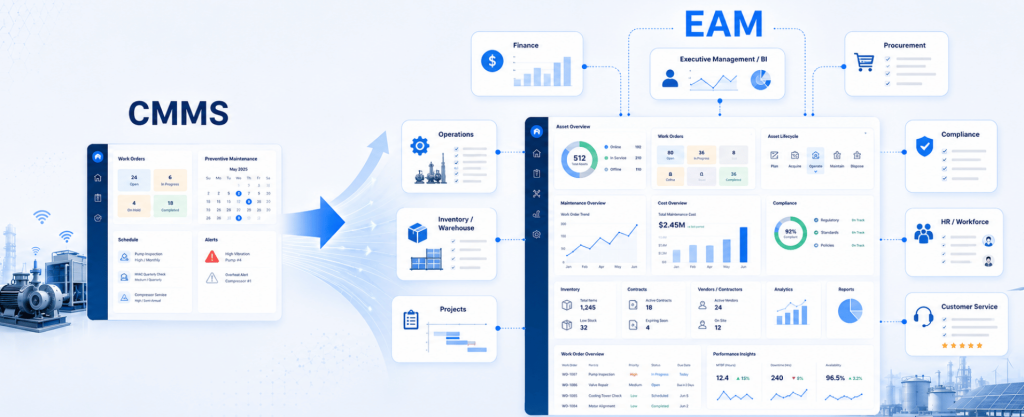
CMMS focuses on managing maintenance work, including work orders, faults, and preventive maintenance. EAM manages the full lifecycle of the asset and connects maintenance with operations, finance, procurement, safety, and regulatory compliance.
Yes. An EAM system typically includes all the core capabilities of a CMMS, and adds broader capabilities such as asset management, contractor management, budgeting, SLA management, compliance, BI, and integration with additional enterprise systems.
No. EAM does not replace ERP; it complements it. ERP manages financial and enterprise business processes, while EAM manages the physical and operational reality of assets, maintenance, infrastructure, field work, safety, and asset performance. For asset- and infrastructure-intensive organizations, EAM acts as the operational asset layer that connects field activity with business and financial decision-making.
Sometimes yes, if the need is mainly basic maintenance management. But when there are multiple sites, contractors, budgets, regulatory requirements, and interfaces with additional systems, EAM is usually the more suitable choice.
In most cases, an infrastructure-intensive organization will gain greater value from EAM, because it enables the organization to manage complex assets, linear assets, contractors, regulatory requirements, SLA, budgets, and field data — all in one connected system.


"*" indicates required fields