A complete guide to the data-driven maintenance approach — how it works, when it pays off, and how an EAM system turns alerts into action
In brief: Predictive maintenance is a data-driven maintenance approach that aims to detect early signs of degradation or risk of failure and schedule treatment before the equipment goes down. It can draw on failure history, work orders, inspections, usage data, and operational systems — and does not necessarily require IoT sensors or continuous monitoring.
Predictive maintenance is a data-driven maintenance approach that aims to detect early signs of degradation or risk of failure and address them before the fault affects operations. The prediction can be based on failure and maintenance history, operating and usage data, inspection results, field reports, and control-system data, as well as sensors and IoT data.
Instead of reactive maintenance, where a component is repaired only after it fails, or preventive maintenance, where parts are replaced on a fixed schedule, predictive maintenance makes it possible to schedule the maintenance action as close as possible to the moment it is genuinely needed — before a significant failure develops, but without replacing components early and unnecessarily.
When applied correctly and to suitable assets, predictive maintenance can lead to fewer unplanned shutdowns, less unnecessary replacement of parts, and a longer service life for components, assets, and infrastructure. According to a 2022 report by the U.S. Government Accountability Office (GAO), after 18 months of using predictive maintenance the U.S. Marine Corps reported a 32% reduction in the downtime of amphibious vehicles and a 69% reduction in the maintenance hours of the ground combat systems included in the activity.
Predictive maintenance is especially relevant to asset-intensive organizations, where the shutdown of critical equipment harms service, production, costs, and sometimes safety as well.

The difference between preventive and predictive maintenance is similar to the difference between a periodic medical check-up and tracking data and indicators that reveal a change in a patient’s condition.
Imagine two people. The first goes for a medical check-up once a year, on a fixed date, whether they feel well or not. The second wears a smartwatch that monitors indicators such as heart rate, oxygen level, and sometimes ECG data, and alerts when something deviates from the norm.
The first resembles preventive maintenance: action on a schedule. Sometimes it comes too early and leads to the replacement of healthy parts, and sometimes too late — when the event has already occurred. The second resembles predictive maintenance: making a decision based on data that indicates change, degradation, or elevated risk, in order to perform the treatment at the right time.
The smartwatch is a convenient example of a continuous data source, but predictive maintenance does not necessarily require continuous monitoring. As in medical diagnosis, trends and risks can also be identified through a combination of history, periodic tests, observations, and data gathered from various sources.
The same principle applies to the maintenance of components such as an engine, a pump, a turbine, a rail, or a train car. Information about an asset’s condition can come from dedicated sensors, but also from engineering inspections, operating data, failure history, and field-personnel reports. A smart system analyzes the data, identifies abnormal trends, assesses the risk of failure, and triggers the treatment process and the relevant teams.
Predictive maintenance is a data-driven maintenance strategy, but whereas condition-based maintenance triggers treatment when a deviation or degradation in the asset’s condition is detected, predictive maintenance uses data and trends to assess in advance the risk of failure and the appropriate time to intervene. The information can come from indicators such as vibration, temperature, pressure, current, flow, noise, or energy consumption, but also from work-order history, failure frequency, operating hours, operating cycles, inspection results, manufacturer data, and technician reports.
Predictive maintenance builds on condition-based maintenance: it adds trend analysis and modeling to estimate an asset’s Remaining Useful Life (RUL) and forecast when a failure is likely, not only whether the current condition has already crossed a threshold. A useful concept here is the P-F interval — the window between the point at which a potential failure first becomes detectable and the point of functional failure. The wider and better-instrumented that window, the more room there is to plan and act in time.
Professional rules, statistical models, and algorithms compare the data with the equipment’s normal operating patterns, identify deviations, and issue alerts when there is degradation or a rise in the risk of failure — before the situation significantly affects operations.
The field continues to grow thanks to improvements in data quality and availability, advances in analytics capabilities, IoT systems, artificial intelligence, and EAM systems. According to a recent market study by MarketsandMarkets, the global predictive-maintenance market is expected to grow from USD 13.89 billion in 2026 to USD 23.79 billion in 2031, at an average annual growth rate of 11.4%.
Predictive maintenance connects asset data with the decision-making and execution processes in the organizational management system. The data can come from sensors and from SCADA or BMS systems, but also from maintenance history, engineering inspections, field reports, and other operational systems.
In practice, the process is built from five main stages:
The loop that connects asset data, analysis, and the work order is the heart of effective predictive maintenance. Without a system that translates the alert or recommendation into scheduled action, the data remains numbers on a screen.
When the system is also connected to ERP, procurement, and inventory, it becomes possible to ensure that the parts, budget, and resources are available at the right time.
The three approaches differ on the question of when treatment is performed, on what basis the decision is made, and what the level of risk and cost is over time.
| Parameter | Reactive maintenance | Preventive maintenance | Predictive maintenance |
|---|---|---|---|
| When treatment occurs | After the equipment fails | On a fixed schedule | When the data indicates degradation or an elevated risk of failure |
| Basis for the decision | An actual failure | Time, operating hours, or usage cycles | Condition, usage, history, and trend data |
| Unplanned downtime | High | Medium | Relatively low |
| Waste of healthy parts | No replacement until failure, but the damage can be severe | Relatively high, because parts are replaced even when healthy | Relatively low |
| Relative cost over time | Usually the highest | Medium | Usually lower for critical, suitable equipment |
| Safety risk | High | Medium | Lower when the degradation can be identified in advance |
| Data and information-infrastructure requirement | Low | Low | Medium to high, depending on the asset and prediction method; sensors are required only where appropriate |
| Fit for critical equipment | Low | Medium | High |
Reactive maintenance may look cheap because it involves no upfront investment, but in asset-intensive organizations it can be the most expensive over time. According to a NIST study on the economics of machinery maintenance in U.S. manufacturing, plants in the top quartile for reliance on reactive maintenance reported 3.28 times more downtime than plants in the bottom quartile. The study’s authors emphasize that some of the comparisons are based on a limited sample and should therefore be viewed as observed correlations rather than proof that the maintenance strategy alone caused all the differences.
Not every asset justifies predictive maintenance. In many cases, the right combination of reactive, preventive, condition-based, and predictive maintenance is what produces the greatest value. This is the logic behind reliability-centered maintenance (RCM): mapping each asset’s failure modes — often through a failure mode and effects analysis (FMEA) — and matching every mode to the maintenance strategy that fits it best.
It is worth considering a move to predictive maintenance for equipment that is critical to operations, whose shutdown halts service, production, or supply. It is especially relevant when unplanned shutdowns recur, when emergency repairs are expensive, when parts are needed on rush order or work hours are performed under pressure, and when there is a risk of contractual penalties or a compromise to safety.
Also, when fixed maintenance schedules lead to the replacement of healthy parts and the waste of resources, it is worth considering a move to a data-driven approach.
Another important condition is the existence of a basic data infrastructure and an orderly maintenance process — or a willingness to begin systematically collecting information on the most critical assets. In some cases it is possible to start from the information that already exists in the EAM system, in work orders, in inspections, and in operational systems. In other cases it will be appropriate to add sensors or additional monitoring sources.
The cost of downtime is usually one of the main drivers. A NIST study, based on 2016 U.S. industry data, estimated that annual losses stemming from preventable maintenance problems amounted to roughly USD 119.1 billion. Of this sum, about USD 18.1 billion was attributed to downtime, about USD 0.8 billion to defects, and about USD 100.2 billion to lost sales due to delays and defects. This is a historical estimate for certain U.S. manufacturing sectors, not a current estimate for the global industry as a whole.
When the cost of an hour of downtime is high, an investment in predictive maintenance may pay for itself relatively quickly on critical, suitable equipment.
| Predictive maintenance is especially suitable when | Predictive maintenance is less suitable when |
|---|---|
| The asset is critical to operations, safety, or service continuity | The asset is inexpensive, easy to replace, or non-critical |
| Downtime causes significant financial, operational, or safety damage | The cost of collecting data, developing the model, and running the process exceeds the expected benefit |
| There are failure patterns that can be measured and identified in advance | Failure is entirely random and hard to predict |
| Condition, operating, inspection, or maintenance-history data exist that can be analyzed reliably | There is not enough data or an orderly maintenance process |
| The organization wants to move from reactive to proactive management | There is no ability to translate alerts into work orders and field action |
| An EAM system exists that connects alerts, teams, parts, and budget | Alerts remain disconnected from the maintenance and execution system |
Predictive maintenance begins with data about the asset, but it is not complete without a system that manages the asset’s lifecycle and translates the information into action. This is where an enterprise asset management (EAM) system comes in — and it is also where an EAM differs from a CMMS, extending beyond maintenance execution to the full asset lifecycle. GIV Solutions implements smart management solutions powered by the Octave Attune EAM (formerly HxGN EAM) platform. In asset-intensive organizations, these systems connect the various information sources with the management of maintenance, inventory, teams, budget, and performance.
In practice, an EAM system closes the loop. An alert, an inspection result, or the identification of an abnormal pattern can become a work order, with the right part, the available technician, and the appropriate operational window. Every event is recorded, and the resulting history is used to improve the rules, the models, and the decision-making processes over time.
Instead of data scattered across sensors, spreadsheets, disconnected systems, inspection reports, and the accumulated knowledge of technicians, a single information layer is created for all assets. This makes it possible to see not only what happened, but also why it happened, what the level of risk is, what the cost is, what needs to be done, and what the impact is on service availability. This structured, standards-aligned approach — consistent with frameworks such as ISO 55000 for asset management and ISO 13374 and ISO 17359 for condition monitoring — gives teams a common language for asset data, roles, and processes.
The GIV Solutions team accompanies the process along the value chain: from the data-collection stage, through translating alerts and recommendations into work orders, to analyzing asset performance over time. The solutions are tailored to the unique needs of different sectors, including energy and water, rail and transportation, healthcare, smart cities, real estate, campuses, and passive infrastructure.
The value lies not in the technology alone, but in the ability to turn operational data into precise, measurable, and proactive maintenance decisions.
In the world of transportation, assets are often linear and distributed: roads, tracks, bridges, tunnels, signaling systems, electrical systems, wayside equipment, and rolling stock such as cars and locomotives. A fault in critical equipment is not only a matter of repair cost; it disrupts service for thousands of passengers, causes delays, harms infrastructure availability, and of course endangers human lives.
Predictive maintenance can be based on monitoring vibration and wear in wheels and bearings, temperature in braking systems, the condition of electrical and signaling systems, and the inspection and monitoring of defects and indicators related to the elements themselves, such as tracks, roads, and bridges. Alongside these, it is also possible to use the results of engineering inspections, condition reports, failure data, visual documentation, and the history of maintenance work.
By combining the information and identifying degradation early, treatment can be planned before the problem becomes an operational failure. According to a 2024 joint report by UIC and McKinsey, interviews with rail companies indicated that, depending on the type of rolling stock and component, predictive-maintenance applications enabled a 15% increase in reliability, a 20% reduction in maintenance costs, and a 30% reduction in train failures. The study was based on a survey of 11 rail companies in Europe and Asia and on 15 interviews with rail companies and equipment manufacturers around the world, conducted between June and November 2023.
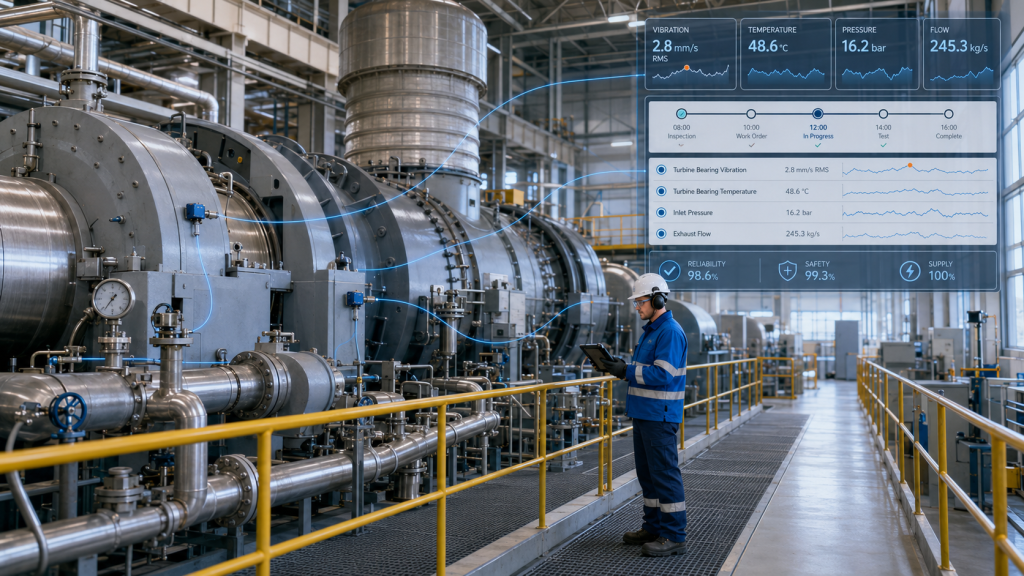
In power plants and water systems, continuity of supply is critical. Turbines, generators, transformers, pumps, compressors, and pipelines operate almost continuously, and the failure of a central component can cause an expensive shutdown, harm to service, a safety risk, and sometimes environmental damage as well.
Monitoring vibration and temperature in turbines and pumps, measuring pressure and flow in water systems, and analyzing electricity-consumption patterns can help identify wear, blockages, imbalance, or a decline in performance before a significant failure develops.
Alongside the monitoring data, it is possible to combine failure history, inspection results, operating hours, SCADA data, operator reports, and previous work orders. Combining the data provides a broader picture of the asset’s condition and its level of risk.
This makes it possible to plan a controlled shutdown for maintenance instead of dealing with a sudden outage. For energy and water organizations, this means maintaining continuity of supply, extending the life of expensive equipment, improving safety, and gaining better control over maintenance and operating costs.
Predictive maintenance begins with a question: when is the equipment or asset likely to fail? By analyzing maintenance, condition, and operating data — and sometimes sensor and IoT data as well — predictive maintenance detects early signs of degradation or risk of failure and makes it possible to schedule treatment at the most appropriate time. This means fewer unplanned shutdowns, less waste of healthy parts, longer asset life, and improved availability and safety.
That said, predictive maintenance does not replace all maintenance methods. From our experience working with organizations, the real value is created by the right combination of reactive maintenance, preventive maintenance, condition-based maintenance, predictive maintenance, and prescriptive maintenance — which directs which actions are recommended following the prediction. Each type of maintenance is chosen according to asset criticality, failure patterns, data availability, and the cost of downtime.
The key to realizing the value is connecting the information sources to an EAM system that translates every alert, deviation, or recommendation into scheduled action: a work order, a technician, spare parts, budget, documentation, and performance analysis over time.
Want to explore how predictive maintenance can fit into your organization’s asset management? Contact the GIV Solutions team and let’s examine together the assets, data, and opportunities best suited to begin the process.
Preventive maintenance is performed on a fixed schedule: at set intervals, after a number of operating hours, or according to a defined number of usage cycles — without full regard to the component’s actual condition. Predictive maintenance is performed on the basis of condition, usage, history, and trend data that indicate degradation or a risk of failure. It therefore makes it possible to schedule treatment closer to the moment it is needed, reduce unnecessary replacement of parts, and cut unplanned shutdowns.
The cost depends on the number of assets, their criticality, the quality of existing data, the complexity of the failure patterns, and the systems that need to be connected. The investment may include cleansing and making data accessible, defining rules and models, integrating alerts into workflows, training teams, and, where appropriate, installing sensors. When high-quality maintenance and operational data already exist, it is sometimes possible to start without a significant investment in new IoT infrastructure, and on critical equipment where the cost of downtime is high, the return on investment can be significant.
Return on investment comes mainly from avoided downtime, fewer emergency repairs, less unnecessary part replacement, and longer asset life. On critical equipment where an hour of downtime is expensive, the investment can pay back quickly. On low-cost or non-critical assets, the data and modeling effort may outweigh the benefit, so the ROI depends heavily on asset criticality and the cost of downtime.
Not necessarily. Predictive maintenance needs data that makes it possible to identify degradation or failure patterns, but the data does not have to come from IoT sensors. Models, rules, and alerts can also be based on failure and work-order history, operating hours, usage cycles, inspection results, technician reports, manufacturer data, and information from SCADA, BMS, or existing operational systems. Sensors are needed when there is no other suitable information source, or when continuous monitoring of indicators such as vibration, temperature, pressure, or flow can significantly improve the ability to detect issues early.
It needs data that reveals how an asset’s condition changes over time. That can include failure and work-order history, operating hours, usage cycles, inspection and test results, technician reports, and manufacturer specifications, as well as sensor readings such as vibration, temperature, pressure, and flow. The right mix depends on the asset, its failure modes, and the data already available.
Predictive maintenance is especially suitable for asset-intensive organizations, where equipment shutdown causes financial, operational, or safety damage. It is relevant to transportation and rail infrastructure, energy and water, healthcare, smart cities, real estate, campuses, and industry. The more critical the equipment and the more expensive the downtime, the greater the potential value of predictive maintenance.
The timeframe depends on the scope of the project, the maturity of the data, the complexity of the assets, and the number of assets included in the process. There is no single timeframe that fits every organization. Early insights can begin to emerge within months when high-quality data and orderly maintenance processes exist, but building reliable models, integrating them into workflows, and measuring business impact may require a longer period. In the GAO report, for example, the results of the Marine Corps pilot were reported after 18 months.
No. In most organizations it is a combination of several maintenance strategies. Predictive maintenance is especially suitable for critical and expensive equipment, where data and failure patterns that can be identified in advance exist. Preventive maintenance, condition-based maintenance, and planned reactive maintenance are still appropriate for assets where the cost or criticality does not justify a prediction process, where there is no failure pattern that can be identified in advance, or where periodic action is required in accordance with manufacturer instructions, regulation, or safety considerations. An EAM system makes it possible to manage all maintenance approaches under a single organizational source of truth.


"*" indicates required fields